

Every family has its rules. In ours, there were three, and they all belonged to Grandma Edie. You took your shoes off at the door. You never left food on your plate. And nobody, ever, under any circumstances, touched the top drawer of the walnut bureau in her bedroom.
It was locked. She wore the key on a thin silver chain around her neck, and in sixty years, as far as anyone knew, she had never once taken it off.
The Extra Plate
There were other strange things about Grandma Edie, small ones that we stopped noticing because they had always been there.
She always set one extra place at the table. Every Sunday lunch, every Christmas, every birthday, there was a knife, a fork and an empty plate at the end, and if a neighbor or a lost student or a friend of a friend turned up, Grandma would wave them in and sit them down as if she had been expecting them all along. If nobody came, she cleared the plate away afterwards without a word.
She kept a small brown suitcase on top of her wardrobe that was never used for holidays. She could not stand to hear a child cry on a train. And although she spoke perfect English, with the faint accent of the town in Yorkshire where she had grown up, she counted under her breath in a language none of us understood.
When I asked about any of it, she would smile and change the subject. “Old ladies are allowed their secrets, Lily,” she would say. “It’s one of the few good things about getting old.”
The Key
Grandma Edie died in the spring, at ninety-four, peacefully, in her own bed. When the nurse handed my mother the few things she had been wearing, the silver chain was among them, with the small brass key still threaded on it.
For a week, nobody touched the bureau. It felt wrong. Then one evening, after the funeral, my mother and her two brothers and I all stood around it in Grandma’s bedroom, and my mother turned the key.
What Was Inside
We had imagined all sorts of things. Love letters. Jewels. A secret first husband. What we found was much smaller, and it took us a long time to understand it.
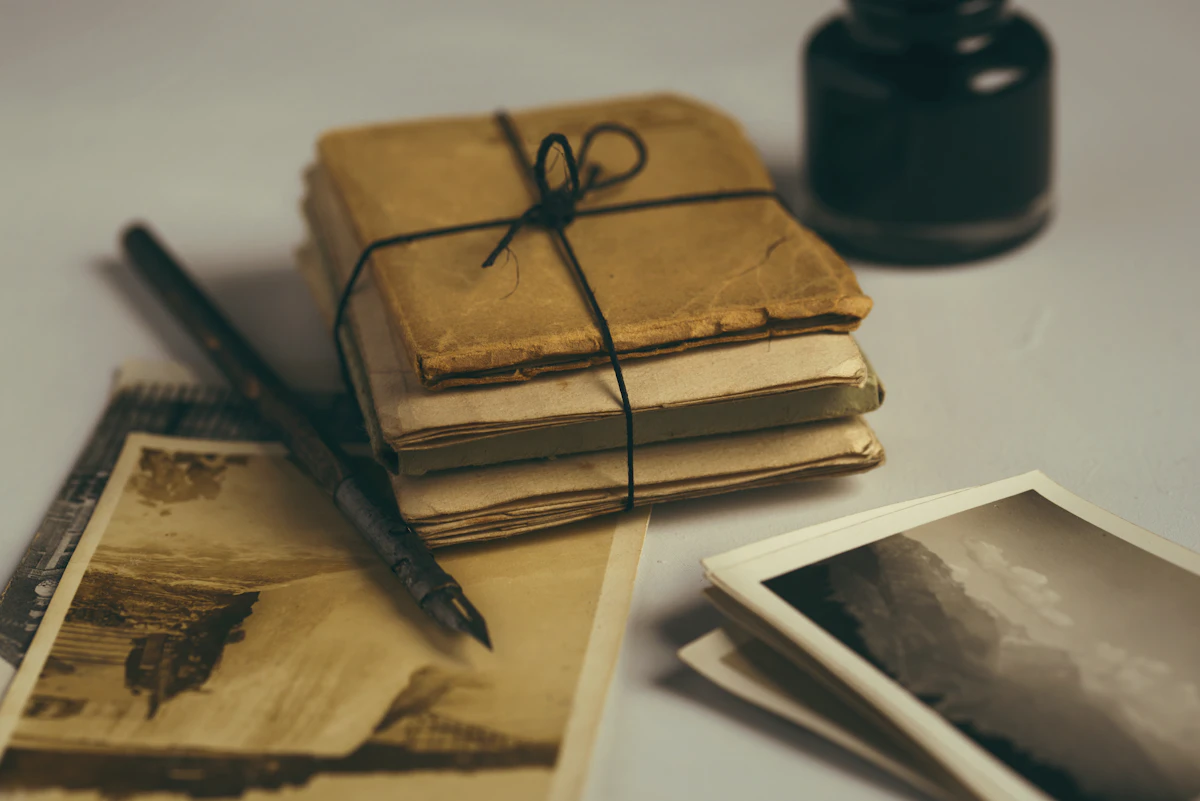
There was a cardboard luggage label, brown and soft with age, tied to a piece of string. On it was a number, 4562, and a name we did not recognize: Edith Lewin.
There was a photograph of a family none of us had ever seen: a man with a beard, a woman with dark hair pinned up, a boy of about twelve and a little girl in a white dress who looked exactly like my mother did as a child.
There was a second photograph of a different family: a round-faced Yorkshire couple standing in front of a terraced house, with a thin, serious, dark-eyed girl of about seven standing between them, holding the woman’s hand.
And there was a letter, in a language my uncle eventually identified as German, written in a careful, loving hand and signed Mama.
The Train
It took us months to put the pieces together, with the help of a historian and a charity that helps families trace their past.
In the winter of 1938 and 1939, in the months before the Second World War, Britain agreed to take in thousands of Jewish children from Germany, Austria and Czechoslovakia, whose families feared for their lives. The children traveled alone by train, without their parents, each with a numbered label around their neck and a single small suitcase. The rescue was called the Kindertransport. Nearly ten thousand children were saved by it.
Grandma Edie had been one of them. Her name had been Edith Lewin. She was seven years old when her mother put her on a train in Berlin with a label around her neck and a letter in her pocket, promising that the family would follow her soon.
They never did. Her parents and her brother did not survive the war.
In England, she was taken in by a couple called Harold and Mabel Brook, who ran a bakery in a small Yorkshire town. They had no children of their own. They raised her, loved her and gave her their name. She became Edie Brook. She went to the local school, lost her accent, married, had children and grandchildren, and never spoke about the train again.
Everything, Explained
Once we knew, everything about her made sense.
The small brown suitcase on top of the wardrobe was the one she had carried on the train. The language she counted in was German, the language of her first family. She could not bear to hear a child cry on a train because she had been one.
And the extra place at the table. We understood that last. It was for whoever might turn up and need somewhere to belong. Because once, a long time ago, a little girl with a number around her neck had stepped off a train in a strange country, and a kind couple she had never met had made room for her at their table.
The letter from her mother, when it was finally translated, was short. It told Edith to be brave, to be polite and to eat everything on her plate. It said that her mother loved her more than anything in the world. And it ended: Wherever you go, make a home, and keep the door open.
She did, for eighty-seven years.
We still set an extra place at Sunday lunch. Sometimes someone comes. Sometimes no one does. But the plate is always there.